


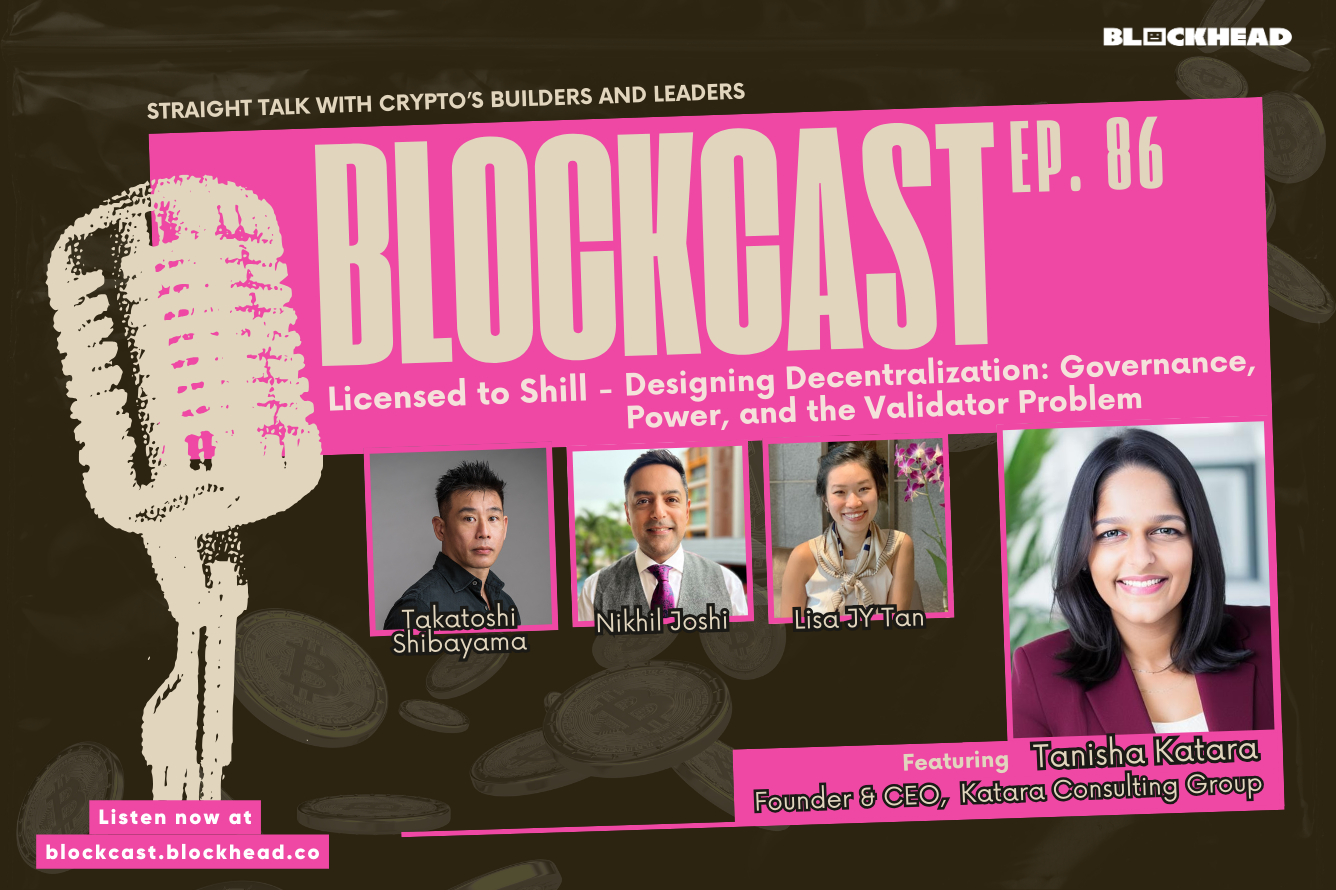
This episode examines what happens when decentralization moves from whitepaper language to operational reality.
Tanisha Katara joins the discussion to unpack three structural tensions inside modern crypto governance: validator power concentration, voter apathy, and the emerging role of AI agents in decision-making systems.
1. Validator Economics and Concentration
Empirical sampling across multiple proof-of-stake networks shows a familiar distribution curve: a small number of validators capturing a disproportionate share of block rewards.
This concentration raises a structural question. If stake determines opportunity, and opportunity compounds stake, decentralization drifts toward economic centralization.
Proposed alternatives include:
- Performance-based validator reputation scoring
- Normalization across active epochs
- Nomination programs to support new entrants
- Separating stake as security collateral from stake as privilege
The design goal shifts from capital dominance to measurable contribution.
2. Governance in Practice
The gap between academic governance theory and protocol operations is substantial.
In practice, systems rely on:
- Constitutional committees
- Delegated representatives
- Threshold-based approval frameworks
- Treasury budget votes with nine-figure allocations
These structures introduce friction: quorum paralysis, delegation fatigue, and role ambiguity.
One emerging approach treats voter apathy as a feature rather than a flaw. Proposals execute by default unless vetoed, reducing noise while preserving intervention rights.
Governance becomes conditional rather than constantly participatory.
3. AI and Agentic Coordination
Experiments with AI agents negotiating governance proposals show that automation does not eliminate coordination challenges.
Findings include:
- Partial consensus driven by model agreement bias
- Fragmented discourse under disagreement
- Small agent clusters disproportionately influencing outcomes
AI systems replicate human coordination patterns at greater speed and scale. They do not inherently resolve concentration or alignment issues.
Core Insight
Decentralization does not eliminate power. It redistributes it across validators, committees, token holders, and increasingly autonomous agents.
Designing governance is therefore an exercise in mechanism design under adversarial conditions. The objective is resilience: systems that remain functional as they scale, even when participation thins or influence concentrates.
Thanks for tuning in! If you enjoyed this episode, please like and subscribe to Blockcast on your favorite podcast platforms like Spotify and Apple .
Blockcast is hosted by Head of APAC at Ledger, Takatoshi Shibayama . Previous episodes of Blockcast can be found here , with guests like Fredrick Gregaard (Cardano Foundation), Daren Guo (Reap), Yat Siu (Animoca Brands), Kean Gilbert (Lido), Joey Isaacson (Nook), Kapil Dhiman (Quranium) Eric van Miltenburg (Ripple), Davide Menegaldo (Neon EVM), Anastasia Plotnikova (Fideum), Jeremy Tan (Singapore parliament candidate), Hassan Ahmed (Coinbase) and more on our recent shows.