Bitcoin fell to a low of $70,623 on Sunday after the United States announced a naval blockade of the Strait of Hormuz following the collapse of peace negotiations with Iran, extending a pattern of geopolitical shocks that has kept the asset rangebound for weeks.
The selloff began after President Trump posted on Truth Social citing Iran's refusal to halt its nuclear programme as the reason talks had broken down. BTC fell 1.9% to $71,686 in immediate response, then dropped further as oil surged 9.5% to $105 a barrel in the half-hour following market open. Bitcoin was down more than 1% on Monday.
The Strait of Hormuz carries roughly 20% of global oil trade, and disruption to the waterway has injected energy price volatility into markets at a scale not seen since Russia's invasion of Ukraine in early 2022. Iran had already been levying transit charges of up to $2 million per vessel on ships crossing the strait before the U.S. blockade announcement escalated the standoff.
Bitcoin had briefly pushed to $73,800 before the weekend's events, but was unable to sustain a break above $72,500. It is currently trading below the 100-hour simple moving average, with $71,500 acting as near-term resistance and a descending trend line on the hourly chart reinforcing that level at $71,450. The $70,500 to $71,000 range represents the immediate support band, below which $69,200 comes into view.
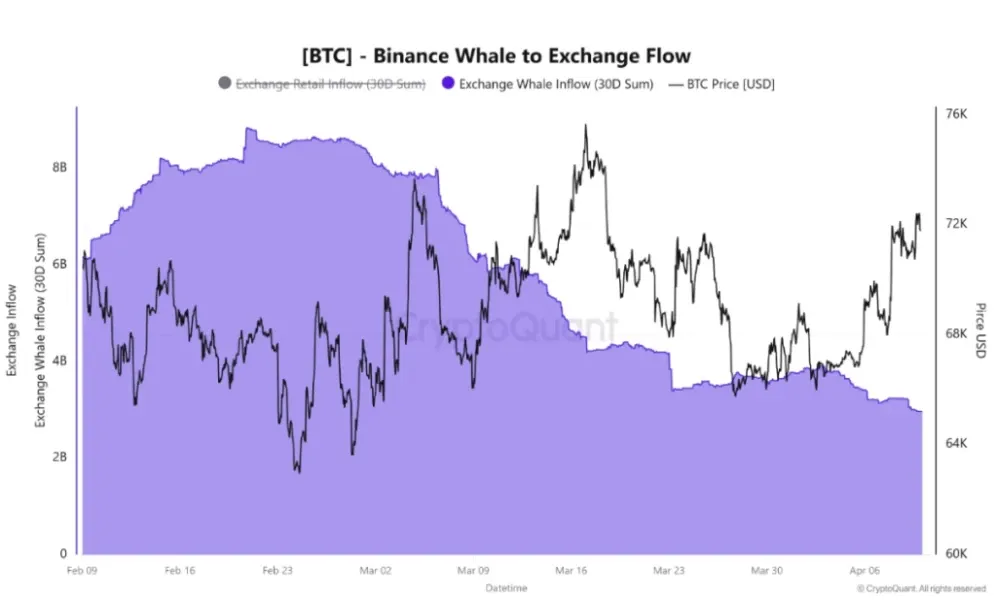
Beneath the price action, onchain data points to a shifting ownership dynamic. Thirty-day total deposits from large holders to Binance have fallen to $2.96 billion — the first time that figure has dropped below $3 billion since June 2025, and sharply down from levels that exceeded $8 billion in February and early March. Declining exchange inflows from large players typically indicate reduced selling intent, a meaningful signal regardless of the macro backdrop.
Long-term holders appear to be adding into the weakness. The 30-day change in realised cap for long-term holder cohorts peaked at $49 billion on April 9, while short-term holder realised cap has dropped by $54 billion over the same period — the third decline exceeding $50 billion since early March. The pattern suggests investors with shorter time horizons are exiting while those with longer conviction are absorbing supply.
Derivatives markets present a different kind of risk. Open interest rose from $21.87 billion on April 6 to $24.37 billion by April 10, while funding rates have turned negative, indicating that short positions are paying longs to hold their stance. The combination of rising open interest and negative funding points to an accumulation of leveraged shorts that could unwind sharply if price holds support and moves higher.
The geopolitical backdrop has clouded an otherwise constructive medium-term picture. Since U.S.-Iran tensions escalated on February 28 — following a U.S. airstrike that killed Supreme Leader Ayatollah Ali Khamenei — Bitcoin has gained approximately 7.4%, outperforming both the S&P 500 and gold over the same period. A two-week truce announced by Trump had briefly lifted risk assets before this weekend's breakdown reversed the sentiment.
Sustaining a close above $71,000 through the end of the week would be an early constructive signal. InvestTech's algorithmic analysis places Bitcoin within a rectangle formation bounded by support at $66,557 and resistance at $72,872, with a decisive break of either level expected to set the next directional move. The firm notes the RSI is in a rising trend and assesses Bitcoin as technically positive in the short term, though it flags that a downward break of $71,000 would constitute a negative signal. Beyond that level, resistance clusters between $72,000 and $73,000, with $74,000 representing the next significant hurdle for bulls.