


Oklo stock has done something in April 2026 that most pre-revenue companies don’t get to do: it became a genuine momentum story with institutional backing, a federal government partnership, and a 50%+ gain in under a month. OKLO ran from $48 in early April to an intraday high of $81.50 on April 24 before pulling back to trade around $74 today. The stock is up more than 200% over the past 12 months.
The move isn’t random. Three specific catalysts landed in rapid succession — a DOE policy signal, an HSBC buy initiation, and a partnership with Nvidia and Los Alamos National Laboratory tied to the federal Genesis Mission. Any one of those would move a speculative nuclear stock. All three hitting within days of each other produced one of the most dramatic runs in the small modular reactor (SMR) sector this year.
What the stock does next depends almost entirely on whether Oklo can convert its growing pipeline into actual operating revenue — something it has yet to do in 13 years of existence.
What Is Oklo?
Oklo Inc. (NYSE: OKLO) is a Santa Clara-based advanced nuclear technology company founded in 2013 by Jacob DeWitte and Caroline Cochran. Its primary product is the Aurora Powerhouse — a compact, liquid metal-cooled fast fission reactor designed to produce between 15 and 75 megawatts of electricity. Unlike traditional nuclear plants that take decades to permit and build, the Aurora is designed for off-site manufacturing using standardized modular components, which in theory allows faster deployment and lower construction cost per unit.
The company went public in May 2024 through a SPAC merger with AltC Acquisition Corp., backed by Sam Altman who serves as chairman. DeWitte, the CEO, sits on President Trump’s advisory council — a proximity to AI and energy policy that has become an increasingly valuable asset as the federal government prioritizes domestic AI infrastructure and energy security.
Beyond the reactor itself, Oklo is also developing two adjacent technologies that set it apart from other SMR developers. First, nuclear fuel recycling : Oklo has received over $15 million from the Department of Energy to build a fuel recycling facility in Tennessee. When a fuel rod is removed from a standard nuclear reactor, roughly 95% of its energy remains unused. Oklo’s recycling process converts that used fuel into usable feed for its Aurora reactors — a closed-loop model that addresses both energy density and waste disposal simultaneously. Second, radioisotope production for medical and industrial applications, which provides a potential near-term revenue stream separate from reactor deployment.
Full company information is available at oklo.com and the investor relations section at oklo.com/investors .
OKLO Stock: Key Stats — April 28, 2026
| Metric | Value |
|---|---|
| Current price | ~$74–75 |
| 52-week range | ~$11 — $81.50 |
| Market cap | ~$6.5 billion |
| Revenue | $0 (pre-revenue) |
| 2025 operating loss | $139.3 million |
| Cash / liquidity | ~$1.2 billion (no debt) |
| Customer pipeline | ~14 GW |
| First commercial operation target | Late 2027 (Idaho National Laboratory) |
| Analyst consensus | Strong Buy (15 analysts) |
| Average 12-month price target | $99.32 |
| Exchange | NYSE |
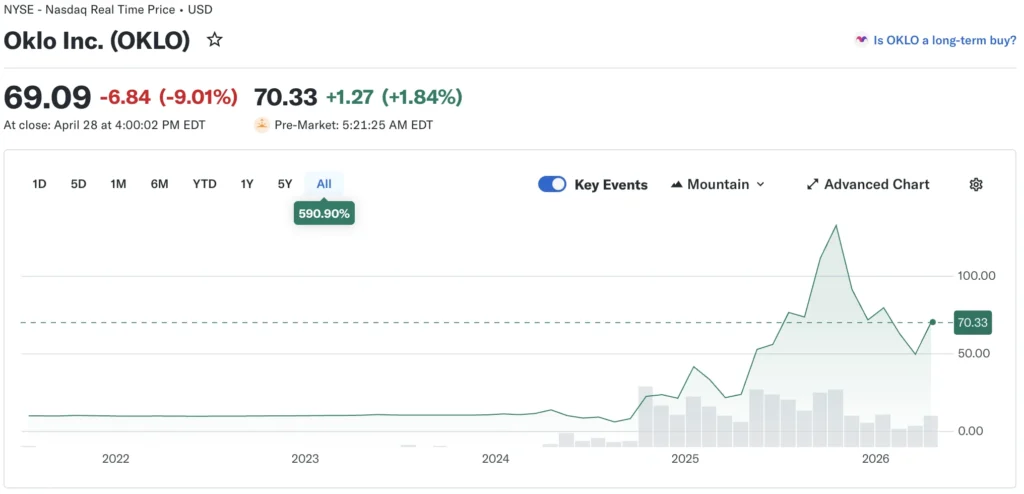
Live price data is available at finance.yahoo.com/quote/OKLO .
What Moved OKLO in April 2026
Three catalysts converged in a short window. Understanding each one matters because the stock’s reaction — and any subsequent pullback — is largely a function of how durable these developments are versus how much was already priced in at $74.
1. DOE Loan Signal (April 16)
In Congressional testimony on the FY27 Department of Energy budget, the US Energy Secretary told lawmakers that the first 5–10 new nuclear reactors will “almost certainly” receive DOE loans. Oklo was named explicitly alongside NuScale, Nano Nuclear, and Fermi as a likely beneficiary. For a capital-intensive pre-revenue company building first-of-a-kind nuclear infrastructure, federal loan backing doesn’t just provide cheap financing — it provides the kind of government endorsement that validates the technology in the eyes of commercial customers. The Idaho National Laboratory Aurora project is directly in scope for this loan program.
2. HSBC Buy Initiation (April 23)
HSBC initiated coverage of OKLO with a Buy rating and a $96 price target, adding institutional legitimacy to a stock that had previously been covered primarily by smaller research firms. HSBC’s initiation signals that major bank research desks are now treating Oklo as a serious investment thesis rather than a speculative bet. The $96 target implies approximately 28% upside from the current $74 level.
3. Nvidia + Los Alamos Partnership (April 23)
The single largest catalyst. Oklo announced a three-way collaboration with Nvidia and Los Alamos National Laboratory to apply AI and advanced computing simulations to design and validate next-generation nuclear fuels and reactor technologies. CEO Jacob DeWitte stated the partnership would “significantly accelerate” development of the Pluto reactor design and support atomic-powered data centers for the federal Genesis Mission — a government initiative connecting 17 national laboratories to advance breakthrough energy technologies using AI and quantum computing.
The Nvidia connection is significant beyond the research value. Nvidia is the most credible name in AI infrastructure on the planet right now. When Nvidia’s brand attaches to a pre-revenue nuclear company, it signals that the data center power problem — finding clean, reliable, on-demand energy for AI computing infrastructure — is real enough that the world’s leading AI chip company is actively pursuing nuclear solutions. For Oklo’s stock, that association with the AI infrastructure narrative is worth multiples of what the research partnership itself is worth in near-term revenue.
On April 23, OKLO rallied 15.65% on the Nvidia news. The following day it hit $81.50 intraday before profit-taking pulled it back to $71 at close — a 7.14% reversal that left the stock still up more than 10% on the week.
The Business Model: What Oklo Actually Does and How It Makes Money (Eventually)
Oklo doesn’t make money yet. Its 2025 operating loss was $139.3 million. It has $1.2 billion in liquidity and carries no debt, which means it can fund operations for several years without needing additional capital. But the clock is running.
The revenue model, when it materializes, works like this: Oklo builds Aurora Powerhouses and sells electricity on long-term power purchase agreements (PPAs). The customer gets guaranteed clean baseload power at a contracted price. Oklo gets recurring revenue for the life of the plant. The model is analogous to how solar farms work financially — capital intensive upfront, recurring cash flow thereafter.
The customer pipeline is the most compelling part of the story. Oklo has non-binding letters of intent totaling approximately 14 gigawatts of contracted pipeline, including:
- A 12 GW data center power deal with Switch , one of the largest data center operators in the US
- A letter of intent with Equinix , another major data center company
- A 1.2 GW campus in Ohio supporting Meta Platforms’ data center operations, expected online by 2030
- Multiple government and defense customers through the Genesis Mission alignment
14 GW is a large number. To put it in context, the entire US nuclear fleet generates approximately 100 GW total. Oklo’s pipeline, if fully executed, would represent 14% of current US nuclear capacity — built by a company that has never operated a commercial reactor.
The critical qualifier: these are non-binding letters of intent, not signed contracts with payment obligations. They represent customer interest, not committed capital.
Regulatory Path: The Real Timeline
Every OKLO investment thesis runs through the US Nuclear Regulatory Commission (NRC), and understanding the regulatory path is essential for realistic timeline expectations.
Oklo’s first Aurora Powerhouse is being deployed at Idaho National Laboratory (INL) under the DOE’s Reactor Pilot Program — a pathway that allows the first testing phase to bypass the traditional commercial NRC licensing route. The DOE’s Idaho Operations Office approved a Nuclear Safety Design Agreement for the Aurora at INL in March 2026, a meaningful regulatory milestone that confirms the project is advancing through the federal authorization process.
Target first operations at INL: late 2027 . That’s the most optimistic scenario, contingent on no permitting delays, no construction setbacks, and continued DOE cooperation.
For subsequent commercial deployments — the Switch, Meta, and Equinix projects — Oklo will need full NRC commercial licenses. NRC licensing for novel reactor designs is a multi-year process with no guaranteed outcome. Oklo submitted its first NRC license application in 2020; it was returned in 2022 due to insufficient technical information. The company has been working to address those gaps. Analysts generally do not model first commercial revenue before 2027 and do not expect GAAP profitability until the early 2030s .
The regulatory risk is real and it’s the primary reason that even bullish analysts include significant uncertainty bands in their price targets.
The AI + Nuclear Intersection: Why This Story Has Changed
The energy demand story behind Oklo is not speculative. It is a documented infrastructure problem that the largest technology companies in the world are actively trying to solve.
Training a large AI model requires enormous, sustained computing power. Running inference at scale requires more. Data centers that house the GPU clusters running these workloads consume electricity at industrial scale — and they need it 24/7, not just when the wind blows or the sun shines. That requirement — clean, reliable, baseload power that can be co-located with or near a data center — is exactly what SMRs like the Aurora are designed to deliver.
Microsoft is resurrecting Three Mile Island to power its data centers. Amazon and Google have signed nuclear power agreements with existing operators. Meta is the anchor customer for Oklo’s Ohio campus. The pattern is clear: hyperscalers are treating nuclear power as a strategic infrastructure requirement for AI deployment, not an ESG gesture.
As BlockchainReporter has documented in its coverage of AI and blockchain infrastructure development , the energy demands of advanced computing are reshaping capital flows across the entire technology sector. Nuclear’s role in that story — providing the only clean energy source capable of delivering firm baseload power at data center scale — is what has fundamentally changed the valuation framework for companies like Oklo.
The broader energy and market context, including how oil price volatility and geopolitical events are affecting energy stocks, is tracked in BlockchainReporter’s latest market news .
Analyst Ratings and Price Targets
| Analyst / Firm | Rating | Price Target |
|---|---|---|
| HSBC (new, April 23) | Buy | $96 |
| B. Riley Securities | Buy | $92 |
| Consensus (15 analysts) | Strong Buy | $99.32 |
The $99.32 consensus target implies approximately 33% upside from current levels around $74. No analysts currently have a Sell rating on OKLO. The range of targets reflects genuine uncertainty about regulatory timing and execution rather than disagreement about the underlying thesis.
For real-time stock data and analyst updates, TradingView’s OKLO chart page tracks live price action and technical indicators.
The Risk Case: What the Bears Are Right About
Oklo is genuinely high-risk. The bull case is real — but so are the structural problems.
No revenue. Oklo has been operating for 13 years and generated zero commercial revenue. The 2025 operating loss was $139.3 million. Even under optimistic scenarios, first commercial revenue is 18 months away and profitability is roughly a decade away. Any investor buying OKLO today is buying a promise backed by a pipeline, not a business backed by cash flows.
NRC licensing uncertainty. The 2022 license application return is a precedent that matters. Novel reactor designs face longer, less predictable regulatory timelines than the industry consensus models assume. A second significant regulatory setback would materially reset the stock.
Insider selling. On April 3, CEO Jacob DeWitte sold 200,000 shares at $50.35. Insider selling at a pre-revenue company in the midst of a momentum run is a signal worth watching, even if the transaction had legitimate reasons behind it.
LOI vs. contract. 14 GW of non-binding letters of intent is not 14 GW of signed revenue. If market conditions shift, data center buildout slows, or a competing technology (grid-scale batteries, next-generation gas, other SMR developers) makes more progress, those LOIs can be withdrawn without penalty.
Valuation. At $74 and a $6.5 billion market cap, OKLO is priced for a future that starts delivering in 2027 and scales through 2030. That pricing requires no regulatory delays, no execution failures, and continued AI/data center demand growth. The margin for error is thin.
What to Watch Next
Q1 2026 earnings — the next scheduled financial report will update the cash burn rate and potentially provide color on DOE loan application progress. Any update on the INL construction timeline will move the stock.
NRC licensing progress — any formal NRC filing acceptance or milestone completion for commercial license applications is a significant positive catalyst.
Switch contract conversion — the 12 GW Switch LOI is the largest single item in the pipeline. Any announcement of a binding PPA would be a major re-rating event. Continued silence on contract execution is the primary overhang.
DOE loan application — following the Energy Secretary’s congressional testimony, formal DOE loan application submission and any stage-gate approvals will provide hard evidence that the financing pathway is real.
For investors tracking how energy infrastructure investments intersect with the digital asset and AI sectors, BlockchainReporter’s cryptocurrency ETF and institutional investment coverage provides context on how institutional capital is flowing across both traditional and digital energy-adjacent assets.
This article is for informational and educational purposes only. It does not constitute financial or investment advice. Stock prices are highly volatile. Always conduct your own research before making investment decisions.