New York, NY, October 13th, 2026, Chainwire
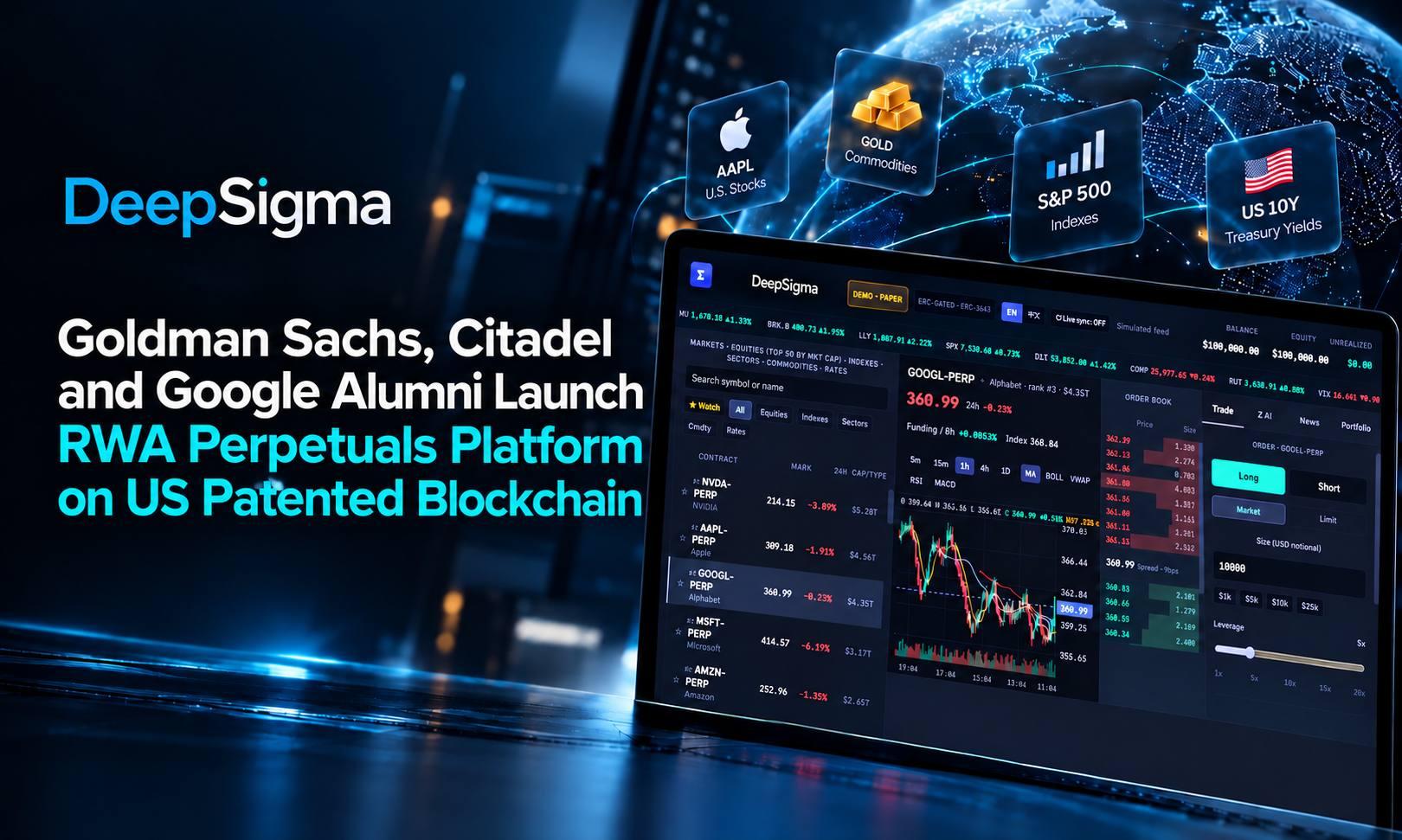
DeepSigma, a new decentralized perpetual futures exchange for real-world assets (RWAs), today unveiled its platform with a live paper-trading demo spanning 77 markets across U.S. equities, indexes, commodities, sector ETFs and Treasury yields.
Powered by the Cypherium blockchain, DeepSigma is being built to bring the perpetual futures model that has grown rapidly in crypto to traditional financial markets. Rather than tokenizing or taking custody of the underlying assets, DeepSigma’s perpetual contracts track their respective real-world markets through external price data, allowing traders to gain long or short exposure without owning or taking delivery of the underlying asset.
The platform is being developed by a team spanning traditional finance, quantitative trading and blockchain infrastructure, with experience at Goldman Sachs, Citadel Securities, Google and Uber.
DeepSigma has also been designed around U.S. regulatory frameworks from day one. The company is working with specialized digital-asset counsel and views regulatory readiness as a market-entry advantage rather than an issue to address after achieving scale.
“Crypto has already demonstrated the demand for perpetual markets, but you cannot simply take the same model and put a stock or commodity ticker on it,” said Sky Guo, CEO of DeepSigma and founder of Cypherium . “Real-world markets have different trading hours, liquidity conditions, pricing sources and regulatory considerations. We started DeepSigma with those differences in mind.”
Building Perpetual Markets for Assets That Don’t Trade Like Crypto
DeepSigma’s live demo currently supports paper trading across 77 RWA perpetual contracts, including leading U.S. equities; the S&P 500, Dow Jones Industrial Average, Nasdaq Composite, Russell 2000 and VIX; S&P sector ETFs; commodities including WTI and Brent crude oil, gold, silver, natural gas and copper; and U.S. Treasury yields.
Unlike crypto assets that trade continuously on largely crypto-native venues, real-world assets can stop trading overnight or over weekends while related markets continue moving. They can also face fragmented price discovery and periods of thin liquidity.
DeepSigma’s technical architecture is being designed around those differences. Its risk framework includes multi-source external pricing, mark-price mechanisms intended to reduce the impact of short-term manipulation, position and exposure limits, circuit breakers, partial liquidations and an insurance mechanism for stressed market conditions.
The platform uses a central limit order book model, with a clearing layer responsible for positions, collateral, margin and settlement.
“The hardest part of bringing real-world assets on-chain isn’t creating another market symbol. It’s making sure the market still behaves sensibly when the underlying asset is closed, liquidity disappears or an external price moves sharply,” said Guo. “Those are market-structure problems, and they have to be part of the architecture from the beginning.”
DeepSigma’s trading terminal currently combines paper-trading functionality with market data, technical indicators, asset-specific news, portfolio tracking and a competitive leaderboard. An AI Market Analysis Desk can analyze markets and generate potential trading strategies, but operates entirely off-chain with zero authority to execute trades or move user assets.
Prove Eligibility, Not Identity
Identity is another area where DeepSigma is taking a different approach from fully permissionless perpetual venues.
The company is developing decentralized identity infrastructure around the principle of “prove eligibility, not identity.” The proposed architecture uses zero-knowledge proofs to allow a participant to demonstrate that they meet required criteria without publishing the underlying personal information on-chain.
The approach forms part of DeepSigma’s broader strategy of designing around U.S. regulatory frameworks from the beginning while preserving as much of the privacy and user control associated with decentralized markets as possible.
Powered by Cypherium and Patented Blockchain Technology
DeepSigma is powered by Cypherium, the open, permissionless Layer 1 blockchain founded by Guo.
Cypherium’s technology is protected by four granted U.S. patents covering blockchain consensus and related technology: U.S. Patent Nos. 12,443,569; 11,907,174; 11,516,006; and 11,411,721.
Its architecture combines Proof-of-Work with HotStuff-derived Byzantine Fault Tolerant consensus. The technology provides the underlying blockchain infrastructure on which DeepSigma is being developed. Cypherium is designed to process hundreds of thousands of transactions per second, providing the throughput needed to support high-frequency, on-chain financial activity.
Guo, a named inventor on Cypherium’s patented technology, previously co-authored DLT Options for CBDC with Thomas Moser of the Swiss National Bank and has spoken at the United Nations Headquarters and Nasdaq.
DeepSigma’s wider leadership team includes Albert Xu, CFO , a former FICC portfolio manager at Goldman Sachs and serial technology founder; Chaoran Wang, CTO , a former Google and Uber engineer and founder of quantitative trading firm UmiUmi; and Jenny Chen, Chief Quant Director , a quantitative macro trader, Forbes 30 Under 30 Finance honoree and most recently at Citadel Securities.
“DeepSigma brings together two areas that have largely developed separately: the market structure and risk discipline of traditional finance, and the open infrastructure that has made on-chain perpetuals successful,” Guo said. “The opportunity is not to copy one market into the other. It is to build infrastructure specifically for where the two meet.”
About DeepSigma
DeepSigma is a decentralized perpetual futures exchange for real-world assets, powered by the Cypherium blockchain. Designed around U.S. regulatory frameworks from day one, DeepSigma is developing perpetual markets spanning equities, indexes, commodities and rates, with infrastructure built around the distinct pricing, liquidity and market-structure requirements of real-world assets. Its live demo currently supports paper trading across 77 RWA perpetual markets, alongside market data, technical analysis and AI-powered trading insights.
Contact
Sky Guo
[email protected]
This article is not intended as financial advice. Educational purposes only.