



BNB Chain put numbers on its second Layer 1 on 26 November. The litepaper for the network it calls New L1 fixes a 200 millisecond block interval, a pre-confirmation stream of small transaction groups pushed out at roughly 20 millisecond intervals, ordering finality inside one block interval plus network round-trip time. Under normal load the paper puts execution finality at about 500 milliseconds plus round-trip time, and section 8 gives the design target: 100,000 transactions per second.
None of that is running in production. The documentation describes a multi-validator devnet with real block production and end-to-end finality, and puts public testnet and mainnet ahead of it. The blog post that introduced the paper says the public testnet is being worked towards and gives no date. That gap is the story: a specification deep enough to argue about, attached to a release schedule that still has two stages to clear.
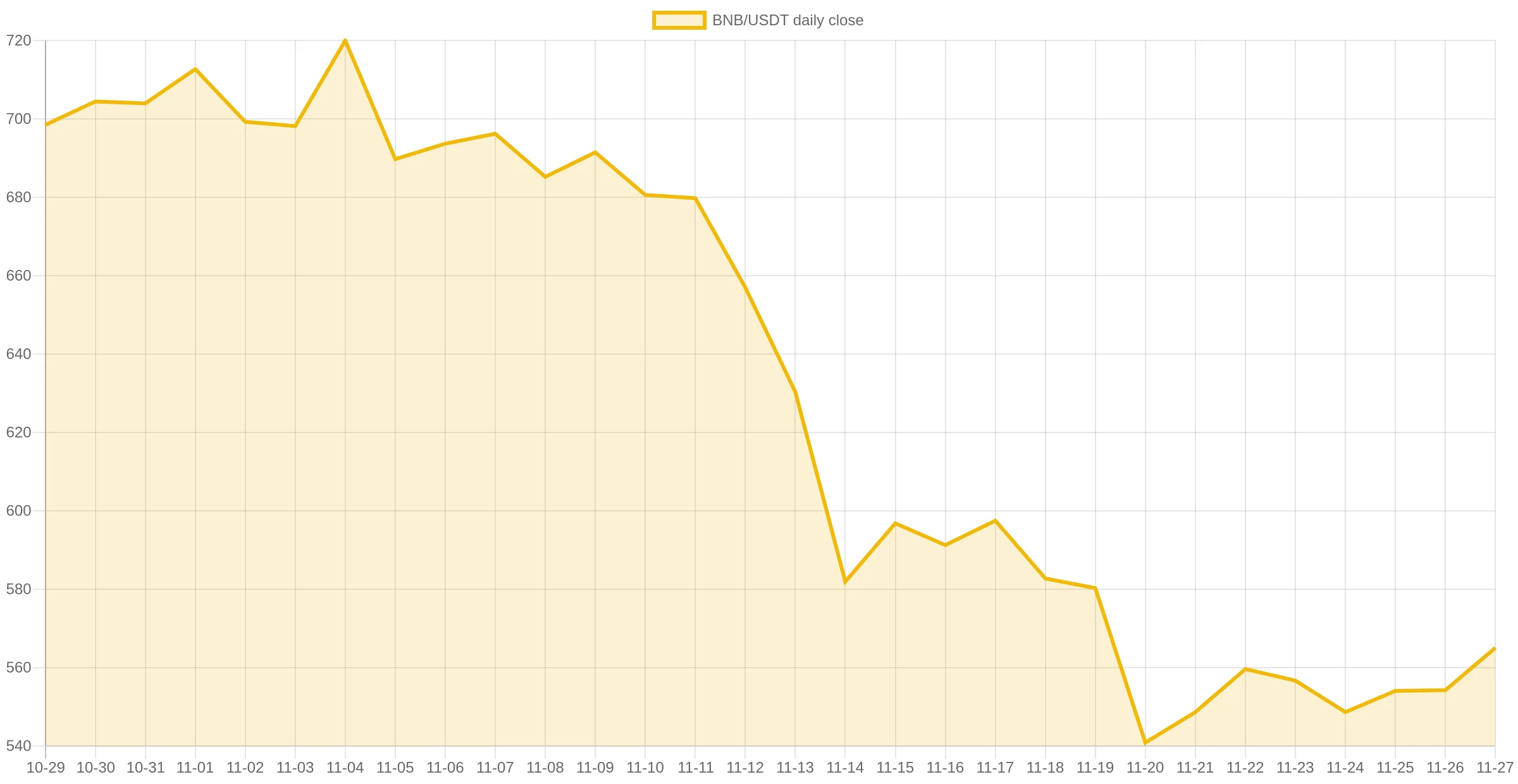
BNB traded at $565.02 on Binance spot at 04:40 UTC on 27 November, up 0.77% over 24 hours. CoinGecko priced it at $563.59 at 04:38 UTC with a $74.1 billion market cap and a circulating supply of 131,509,901 tokens, which is 58.9% below the October 2025 high of $1,369.99. Over the past 30 daily closes the token has fallen 19.1%, from $698.46 to $565.03, so the paper landed in a market that has already repriced the whole complex.
What the paper fixes and what it postpones
The fixed part is unusually specific. Block interval is 200 milliseconds. Validators rotate every 16 blocks. Ordering finality needs at least one block interval plus network round-trip time, and execution finality needs a later block to record the execution commitment and finalise. BNB is the only native asset, bridged from BNB Smart Chain, and staking it through StakeHub mints govBNB, a non-transferable voting ledger that carries governance weight once delegated.
The postponed part is just as specific. Parallel EVM execution is listed as planned. Protected ordering through a trusted execution environment gateway is listed as proposed. The official bridge between BSC and New L1 is described as ready for launch with Devnet-2, which is a statement about software, not about a live transfer route. The blog was blunt about the split: “Availability depends on the network release and configuration. Parallel EVM execution is planned. Protected ordering through a trusted execution environment (TEE) gateway remains proposed.”
The sequence decides how much of the pitch can be tested this year. The parts that exist on the devnet are ordering, execution, account abstraction, lanes and the shielded pool. The parts that would make the chain attractive to a professional venue, meaning parallel execution and pre-ordering protection against front-running, are still directions rather than features.
200 milliseconds against BSC’s 450
The comparison BNB Chain invites is with its own general-purpose chain, and the arithmetic is simple. BNB Smart Chain runs 0.45 second blocks on mainnet, down from 3 seconds through the Lorentz, Maxwell and Fermi hardforks, with finality of about one second when fast finality is enabled. At 450 milliseconds that is 192,000 blocks a day. At 200 milliseconds it is 432,000, or 2.25 times as many.
The pre-confirmation number is the sharper one. Twenty milliseconds is one tenth of a block interval and 22.5 times shorter than a BSC block. Applications are meant to learn that a transaction is likely to be included before a block exists, which is the difference between a quote that can be refreshed and one that goes stale while a market maker waits. The paper is careful about what that signal means: it can be replaced, it does not establish finality, and network and queueing delays sit on top of it.
The throughput target converts into a per-block load. “New L1 has a design target of 100,000 transactions per second (TPS).” At 200 millisecond blocks, 100,000 transactions a second means 20,000 transactions per block, and 8.64 billion transactions across a full day at that rate. Those are arithmetic consequences of the target, not a forecast of demand, and the paper’s own limits point the same way: under heavy load execution may lag by up to eight blocks, which is 1.6 seconds at the target cadence, and block production pauses to let execution catch up.
The fee rule that punishes a bad gas estimate
New L1 charges for the gas a transaction declares rather than the gas it uses. The paper states it plainly: “For ordinary included account transactions, fees are based on the declared gas limit, including when application execution fails.” Unused gas and storage refunds do not reduce the charge, so a wallet that declares 500,000 gas for work that consumes 150,000 pays for more than three times the computation it asked the network to perform.
That is a deliberate trade. Pre-charging the declared limit lets a producer reserve capacity before execution runs, which is what makes reserved lanes and sub-second ordering possible. It also moves a cost that used to be invisible into the wallet’s estimation logic. For a payment app the difference is pennies. For a venue sending thousands of quote updates an hour, a systematic 3.3 times over-declaration is a 3.3 times fee bill, and the estimator becomes part of the trading stack.
The rest of the fee design is unusual. “The base fee remains zero even under load.” Users and sponsors still pay transaction fees and still compete for finite block capacity, and account abstraction lets a paymaster quote a fee in a stablecoin while paying the network in BNB. Sponsorship changes who pays. The paper is explicit that it does not remove the cost.
LtHash saves state work and removes a proof primitive
State is recorded with LtHash, an incremental accumulator that updates the commitment for entries that changed instead of rebuilding a tree. That reduces maintenance work as the chain grows. The cost is written into the paper: “The tradeoff is proof support. LtHash does not provide the account and storage membership proofs that applications may expect from a Merkle-based state tree.”
The documentation lists the consequences for builders. The eth_getProof method is unsupported. EIP-4844 and EIP-7702 transactions are unsupported. Any application that verifies account or storage membership onchain needs a separate path, and the paper tells developers not to assume Ethereum-style proofs exist. Wallets, indexers and bridges that lean on those proofs are the integrations most likely to break first, which is why the migration guide, not the marketing page, is the document to read before committing engineering time.
The paper is equally direct about what a shared token does not buy: “A shared asset denomination does not automatically share validator security, liquidity or bridge guarantees.” BNB is the same asset on both chains, and the security assumptions, liquidity depth and bridge risk are not.
Reserved capacity is sold, not guaranteed
Multi-lane allocation reserves part of each block for eligible activity, such as payments or a trading venue’s flow. Unused capacity returns to the general lane, and dedicated traffic can still compete in the general lane when it needs more room. The honest limit is in the text: “A reserved share does not guarantee that every individual transaction meets a deadline.”
The design decision to watch is what gets sold. The chain is not selling priority per transaction. It is selling a class of traffic a share of every block, with eligibility and scheduling defined in protocol configuration and governance controlling the parameters. The commercial question that follows is who qualifies for a lane, how the quota is set, and whether a venue with a large reservation can crowd the general lane during the exact minutes when retail flow needs it. The paper answers the mechanics and leaves the allocation policy to governance.
Privacy that stops where a position persists
The shielded pool holds BNB and admitted BEP-20 tokens. Ownership is proved with a unified zero-knowledge STARK that binds the recipient, the fee and the public operation, nullifiers prevent double spending, and viewing keys give scoped read access without spending authority. Deposits, withdrawals, fees and the amounts on public results stay visible, and the paper says network and timing metadata can still link activity.
The boundary is AtomicCall, which lets shielded assets fund an admitted public operation that returns an asset within the same flow, such as a swap. It does not create a controller for a persistent lending position. A successful call produces a result note, a failed child execution returns the principal as a refund note, and the settled fee is kept. That covers payments and swaps. It does not cover the leveraged strategies that generate most of the fee revenue on a trading chain, and the paper lists verifiable disclosure of a note’s spent status as an open design item.
There is also no unconditional promise at the exit. The paper says governance and emergency controls affect upgrades and exits, and that the design makes “no unconditional withdrawal guarantee through every failure state.” A privacy pool attached to a venue chain is a compliance-sensitive product, and the paper is more candid about that than most launch documents.
What BNB holders get, and what they do not
There is no new token. BNB pays gas on New L1, moves between the two chains through the native bridge, and accrues governance weight through govBNB. That removes dilution risk and removes the separate asset that would otherwise let the market price the new chain on its own. The read-through runs through BNB’s fee and staking demand, and the paper does not quantify either.
The supply picture gives the size of the existing burn programme. The 37th quarterly burn, completed on 19 October, retired 1,646,196.44 BNB and left a remaining total supply of 131,512,085 BNB, against an auto-burn target of 100,000,000. That leaves roughly 31.5 million BNB still to be retired, about 24% of the current supply, which at $563.59 is $17.8 billion of notional supply. The figure is a description of the schedule, not a price floor, and the burn formula has already been re-parameterised once as BSC’s block times fell.
The comparison that is not BSC
The chain New L1 is aimed at is not its sibling. It is the venue layer where perps, tokenised stocks and agent-driven flow currently settle, and that layer is contested. Solana’s 2027 roadmap doubles compute and puts AI models onchain, which is the same bet on latency and programmability from a chain with an existing trading base. On the centralised side, Binance cut its stock-trading fee to 17 cents this week, a reminder that the venue competition is being fought on spreads and take rates, not only on block times.
A 20 millisecond pre-confirmation narrows the gap between an onchain venue and a centralised order book, and that is the pitch. It does not close it. Finality under load is the metric that decides whether a market maker can hold a position on the chain, and the paper’s 500 millisecond figure is explicitly a normal-load number with network round-trip time excluded from the claim.
What would make this real
Four things are checkable from outside, and each has a public artefact. A public testnet with validators the foundation does not operate. Published lane eligibility and quota parameters, so an outside venue can see what capacity costs and who can buy it. A shipped TEE gateway with an attestation design that survives review, since protected ordering is the feature that answers front-running. And a supported replacement for membership proofs, because the LtHash trade-off is currently a gap that every bridge and indexer has to solve alone.
The devnet already produces blocks, which makes the next milestone a scheduling question rather than an engineering rumour. Until the testnet has a date, the 100,000 TPS figure and the 20 millisecond pre-confirmation are specifications a reader can evaluate. The delivery date is the one number the document does not contain.
Frequently Asked Questions
It is a second, EVM-compatible Layer 1 in the BNB Chain family, designed for latency-sensitive activity such as high-frequency trading, payments, private settlement and autonomous agents. It runs alongside BNB Smart Chain, uses BNB as its only native asset, and is currently a multi-validator devnet.
No date has been published. The documentation says public testnet and mainnet are still ahead, and the 26 November blog post says the public testnet is being worked towards. The official BSC bridge is described as ready for launch with Devnet-2.
No. The litepaper states that BNB is the native network token with roles in fees, staking and governance, and that no separate native token is issued. Staking BNB through StakeHub mints govBNB, a non-transferable voting ledger.
No. BNB Smart Chain remains the broad-base chain for the existing ecosystem, and New L1 is a separate environment for workloads that need tighter latency and reserved capacity. Contracts, tooling and liquidity do not move automatically, and the paper warns that shared BNB denomination does not mean shared security or bridge guarantees.
The design sets 200 millisecond blocks, a pre-confirmation at roughly 20 milliseconds and execution finality at about 500 milliseconds plus network round-trip time under normal load, with a 100,000 TPS design target. Under heavy load execution can lag by up to eight blocks before block production pauses to catch up, so the normal-load figures are not a guarantee at peak demand.
Data: BNB Chain New L1 litepaper , BNB Chain New L1 documentation , BSC documentation , BNB Chain 37th burn , CoinGecko , Binance spot BNBUSDT. Prices are the Binance spot print at 04:40 UTC and the CoinGecko print at 04:38 UTC on 27 November 2026.
Disclosure: This article does not represent investment advice. The content and materials featured on this page are for educational purposes only.
The post BNB Chain’s New L1 Litepaper Puts 200 ms Blocks Against a 100,000 TPS Target appeared first on BlockchainReporter .