



When US President Donald Trump announced a two-week ceasefire with Iran on Tuesday evening, the reaction across markets was swift and broad. Oil fell more than 10%, with West Texas Intermediate crude dropping to around $95 a barrel. U.S. equity futures rallied. And Bitcoin, which had slipped to around $68,000 earlier in the session as Trump's deadline for Iran to reopen the Strait of Hormuz approached without a deal, surged above $72,000.
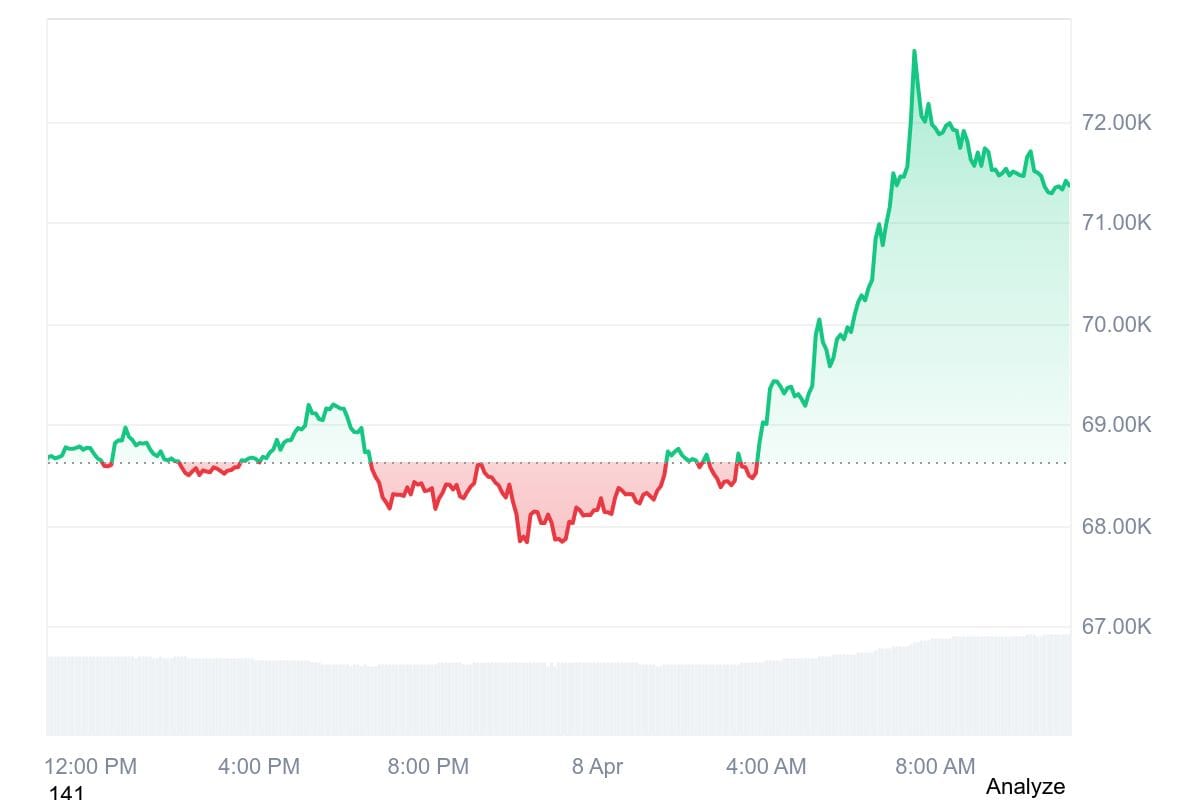
The move illustrates something the crypto market has been trying to deny for weeks: when geopolitical risk spikes hard enough, Bitcoin trades like a risk asset, not a safe haven. And it trades like a risk asset in both directions. The token is up 4% in the past 24 hours, currently sitting at $71,500, with the overall crypto market up 3.68% to $2.44 trillion.
The range that wouldn't break
For nearly two months, Bitcoin has been pinned in a $62,000 to $75,000 corridor, a channel that crystallised once the U.S.-Iran conflict escalated at the end of February. The correlation between BTC and crude oil has been striking: as Brent crude climbed roughly 50% from the start of the conflict, Bitcoin held below $70,000 for most of the prior two weeks. Trump's explicit threat to bomb Iranian civilian infrastructure – "a whole civilisation will die tonight," he posted on Truth Social – briefly pushed WTI crude above $114 a barrel and sent Bitcoin lower as the Tuesday deadline loomed.
The ceasefire announcement reversed all of it in hours. Oil shed double digits. Bitcoin reclaimed $72,000. Ethereum, Solana, and XRP all posted strong gains, outperforming in a broad crypto rally.
What the ETF flows were saying
The day before the rally, institutional money was moving in. U.S. spot Bitcoin ETFs recorded $471.4 million in net inflows on April 6 — the strongest single day since late February and the sixth-largest daily total of 2026 — with BlackRock's IBIT leading at $181.9 million and Fidelity's FBTC contributing $147.3 million.
But April 7 told a different story. The day the ceasefire was announced and Bitcoin surged past $72,000, ETFs swung to $159.1 million in net outflows. FBTC shed $47.8 million, GBTC $41.9 million, and ARKB $34.2 million. IBIT, the largest and typically most resilient product, also flipped negative at -$17.1 million. Only BRRR registered a marginal inflow.
The pattern is worth sitting with. Institutional money accumulating into weakness on April 6, then flowing out on the day prices surged, is consistent with a specific behavior: ETF buyers were buying the dip, not chasing the bounce. When the ceasefire premium pushed Bitcoin sharply higher, some of that capital rotated out, taking profit into the move rather than adding to it.
March as a whole attracted roughly $1.3 billion in net inflows, the first positive month after four consecutive months of outflows dating back to November 2025. April is running well behind that pace. Whether institutional appetite holds through the ceasefire's two-week window is the open question — and the April 7 data does not offer a confident answer.
The fragile bull case
The "bull scenario" that analysts have been mapping is real, and the ceasefire is a version of it, but it comes with qualifications. The ceasefire is two weeks. The Strait of Hormuz reopening is the stated condition. Trump has simultaneously renewed threats against Iranian bridges and power plants. The underlying conflict has not been resolved, merely paused.
The ETF outflows on April 7 add a further note of caution. If institutional participants were selling into the rally rather than adding to it, the ceasefire premium may already be largely priced in — which is the cautious read this conflict's history of escalation after apparent pauses would also suggest.
For crypto specifically, the more structural near-term catalyst that traders are watching is the U.S. Clarity Act, expected to pass in late April. Institutional participants are treating it as a regulatory unlock – a designation that would reframe how digital assets sit within U.S. securities law. If the ceasefire holds and the Clarity Act passes, the argument goes, the macro headwinds that have kept Bitcoin range-bound are replaced by regulatory tailwinds. That is a different thesis than "geopolitical risk goes away," and a more durable one.
The next two weeks will test whether Bitcoin can break out of the range on the upside, or whether Tuesday's move was the extent of the ceasefire trade. The flow data suggests at least some of the smart money has already answered that question for itself.