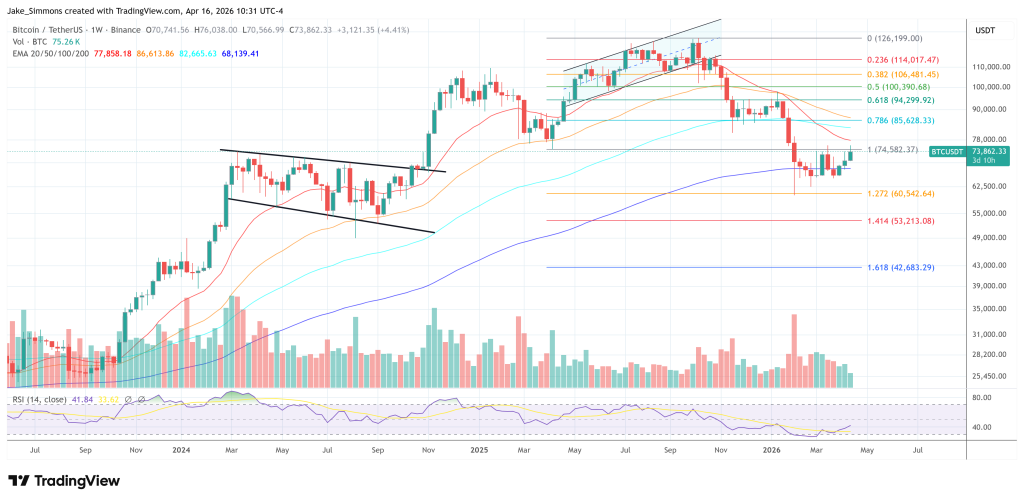
Swan Bitcoin Managing Director John Haar argued on Wednesday that the market’s repeated comparison between the current cycle and the 2022 bear market misses a fundamental point: the backdrop has changed. In a post on X, Haar said Bitcoin’s roughly $65,000 to $70,000 range has acted as a floor for the past two months and may already represent the cycle bottom.
His case rests on a simple distinction. The forces that broke Bitcoin in 2022: inflation shock, aggressive monetary tightening, collapsing liquidity and industry-wide contagion are, in his view, either gone or materially weaker today. “Those predicting a further decline are drawing comparisons to 2022,” Haar wrote. “But the macro, regulatory, and institutional landscape today is fundamentally different. The nine structural factors below illustrate why the 2022 analogy is unlikely to hold.”
A Different Macro Regime
Haar began with the macro backdrop, framing inflation and monetary policy as the first major break from the last cycle. In 2022, he noted, CPI hit a 40-year high, eroding purchasing power and giving the Federal Reserve a clear reason to tighten policy aggressively. Today, he described inflation as having stabilized around 2.5% to 3% year over year, a level he sees as far less threatening to risk assets.
That argument extends to rates, the Fed’s balance sheet and broad money growth. Haar wrote that 2022 brought “the fastest rate-hiking cycle in modern history,” while the present environment is defined by steady or modestly lower rates. He also pointed to what he described as a return of balance-sheet expansion and a multi-year run of month-over-month M2 growth , framing both as liquidity support rather than a headwind.
Fiscal policy features prominently in the thread as well. Haar argued that US deficit spending has remained elevated at roughly 5% to 6% of GDP for more than three years, with no meaningful pullback in sight. Taken together, his message is that the macro engine driving the 2022 unwind has been replaced by one that looks, at minimum, more neutral and potentially supportive.
Contagion, Then And Now
Haar’s sixth point shifts from macro to crypto market structure. In his telling, 2022 was not simply a drawdown but a cascading institutional failure across tightly connected firms. Terra/Luna, Celsius, BlockFi, Three Arrows Capital, Voyager and FTX collapsed in sequence, amplifying losses and destroying confidence across the sector.
He contrasted that period with today’s environment by arguing that institutional counterparties are stronger, even if pockets of stress remain. “BlockFills is an example of institutional failure, but its scale is a fraction of the 2022 failures,” Haar wrote. “This cycle, theories circulate regarding engineered cascading selloffs that ultimately caused leveraged crypto funds to implode.”
Institutional Bitcoin Demand
The final stretch of Haar’s thesis centers on what he sees as the most important difference between cycles: the scale of institutional demand. He wrote that Strategy deployed about $270 million to acquire roughly 8,000 BTC in 2022, compared with $22.5 billion in 2025 for 226,000 BTC and another $8.5 billion year to date in 2026 for 108,000 BTC.
He paired that with the arrival of spot Bitcoin ETFs and a broader shift in institutional posture. “Spot Bitcoin ETFs are live with billions in AUM,” Haar wrote. “ BlackRock is publicly promoting Bitcoin. Morgan Stanley is launching their own spot Bitcoin ETF. Vanguard reversed course and will allow their clients to buy spot Bitcoin ETFs.” He also cited Harvard’s endowment as holding a sizable Bitcoin position and argued that the federal policy tone in the US has become more openly supportive.
Haar stopped short of calling the floor guaranteed. He included a caveat that Bitcoin can still trade below levels that appear technically or structurally supported and warned that shocks ranging from war to supply-chain disruption to energy shortages could still derail the setup.
Still, his broader point was clear: if 2022 was defined by tightening, forced liquidations and institutional absence, this cycle may be defined by liquidity, access and deeper capital pools.
At press time, BTC traded at $73,862.