


The Federal Reserve held its benchmark interest rate steady at 3.5–3.75% on June 17, voting 12-0 to leave policy unchanged at Kevin Warsh's first meeting as Fed chair.
The decision itself was widely expected. What wasn't was the scale of the shift in the projections that accompanied it.
The updated dot plot showed nine of 18 FOMC members now expect at least one rate hike before the end of 2026, with six projecting two. The median 2026 year-end rate forecast moved to 3.8%, up from 3.4% in March. The Fed also raised its PCE inflation forecast sharply – to 3.6% from 2.7% – citing supply shocks including elevated energy prices connected to the conflict in the Middle East. Language indicating a bias toward future cuts was removed from the statement entirely. Warsh said the Fed's commitment to returning inflation to 2% was "strong, unanimous, and unambiguous."
Warsh used the press conference to announce five task forces that will review Fed operations across communications, balance sheet policy, and other areas. Major equity indices cut their initial losses as he outlined those plans. The S&P 500 finished the session down 0.2%, while the Nasdaq and Dow closed roughly flat.
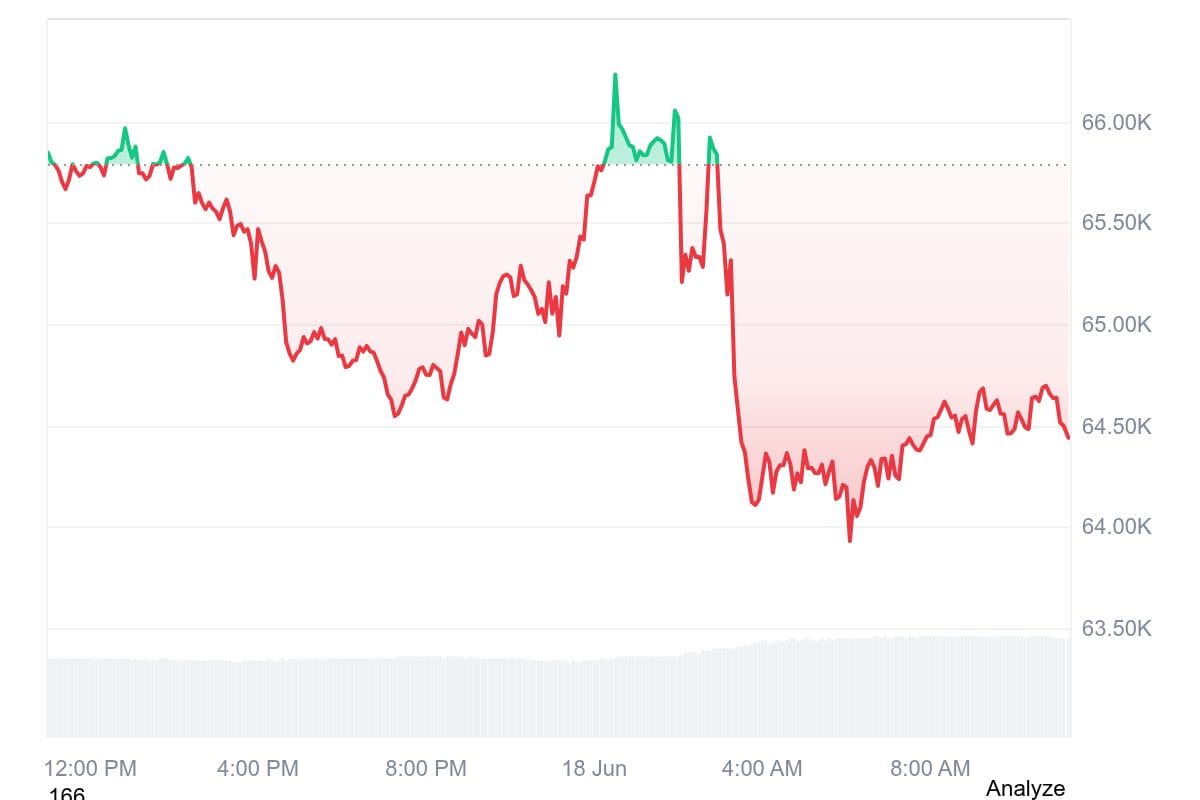
Crypto markets absorbed the hawkish signal harder. Bitcoin, which had been climbed past $66,000 heading into the decision, fell toward $63,000 in the immediate aftermath – a decline of roughly 3%. It's since recovered to around $64,400 as of publication time.
Ether dropped 3.6%, trading near $1,756 the following morning. The Crypto Fear & Greed Index sat at 22, deep in Extreme Fear territory. According to CME Group's FedWatch tool, markets were pricing a 60.7% probability of an October hike by the close of Warsh's press conference.
The macro read for digital assets is straightforward and unfavourable. Higher rates for longer extend the window in which US Treasuries – currently yielding well above 4% – compete directly with Bitcoin for institutional capital allocation. The rate-cut narrative that had underpinned a portion of crypto's recovery thesis in 2025 is now off the table for 2026.
The question for the coming weeks is whether spot demand and onchain accumulation are enough to absorb the macro headwind. In June alone, long-term holders absorbed roughly 125,000 BTC – a signal analysts have historically associated with market bottoms, though the macro backdrop now looks materially worse than when that data was formed.
The next Fed meeting is scheduled for late July. The October meeting is now the one to watch.