


MARA Holdings spent years telling investors that bitcoin on its balance sheet was a strategic asset. Then it started selling. For the nine months to September 30, 2026, the company sold 26,984 bitcoin for about $1.9 billion. After the quarter closed it borrowed $750 million against coins it still held, sold another 13,597 at an average of roughly $81,039, and used the proceeds to repay the loan and take the collateral back. Read in sequence, the numbers describe a trade rather than a retreat: coins borrowed against at about $64,000, coins sold at about $81,039.
That sequence sits inside a much larger figure that began circulating on November 10. Fourteen listed companies have sold 108,247 bitcoin in 2026, worth about $8.08 billion, according to the tally published by Lookonchain . MARA accounts for 40,581 BTC and Riot Platforms for 20,264 BTC. The two together make up 56.2% of everything on the list.
14 public companies have sold 108,247 $BTC ($8.08B) in 2026!
MARA sold 40,581 $BTC ($3.03B) at an average price of $74,446, while Riot Platforms sold 20,264 $BTC ($1.51B) at an average price of $73,231.
— Lookonchain (@lookonchain) November 10, 2026
Bitcoin traded at $73,777 at 05:48 UTC on November 11, down 1.46% over 24 hours and 41.5% below the $126,080 record it set in October 2025, according to CoinGecko . At that price, the 108,247 coins sold this year are worth about $7.99 billion, roughly $89 million less than the dollars the sellers actually raised. On average, the group exited above the current market.
The list splits along a straight line: two miners, then everyone else
MARA’s 40,581 BTC carried a stated value of $3.03 billion at an average price of $74,446. Riot’s 20,264 BTC came to $1.51 billion at an average of $73,231, which is $546 below where bitcoin trades now. The remaining twelve companies do not come close: Bitdeer sold 10,553 BTC for $787 million, Cango 7,001 BTC for $522 million, CleanSpark 5,715 BTC for $426 million, Core Scientific 3,374 BTC for $252 million, Empery Digital 3,170 BTC for $236 million, Keel and Bitfarms 3,169 BTC for $236 million, Hut 8 3,102 BTC for $231 million, HIVE Digital 3,056 BTC for $228 million, IREN 2,774 BTC for $207 million, Cipher Digital 2,252 BTC for $168 million, Sequans 2,139 BTC for $160 million and KULR 1,097 BTC for $82 million.
The structure of that list matters more than its length. A headline number built from fourteen companies sounds like a sector decision. In practice it is two miners managing debt and one battery manufacturer that left bitcoin entirely, with a tail of smaller operators whose sales amount to a rounding error against the two leaders. Strip MARA and Riot out and the other twelve sold just under 47,400 BTC.
The average price is the part the headline buries
Divide $8.08 billion by 108,247 coins and the group’s implied average sale price lands at about $74,600. Bitcoin’s spot price is $73,777. The gap is small in percentage terms, about 1.1%, but it runs the opposite way to the usual assumption about forced sellers. Companies that dump into weakness sell below the market, not above it.
MARA’s own disclosure shows how deliberate the timing was. Its nine-month sales of 26,984 bitcoin raised $1.9 billion, which works out to roughly $70,412 a coin. The 13,597 sold after quarter-end went at about $81,039. That is a 15% improvement on the year’s earlier average, and applied to 13,597 coins it is worth roughly $145 million more than selling them at the nine-month rate. The company describes the result in its own terms: it borrowed against bitcoin “while it was trading around $64,000” and later sold at $81,039, a sequence it says let it “capture an estimated net benefit of $170.0 million.”
The spread across the group is wide. Core Scientific’s stated average of $85,000 is the highest on the table; Empery Digital’s $66,733 is the lowest, a 27% gap between the best and worst execution. Hut 8 at $80,658, Cipher at $75,018 and Keel at $75,601 also cleared the current price. HIVE at $72,133 did not.
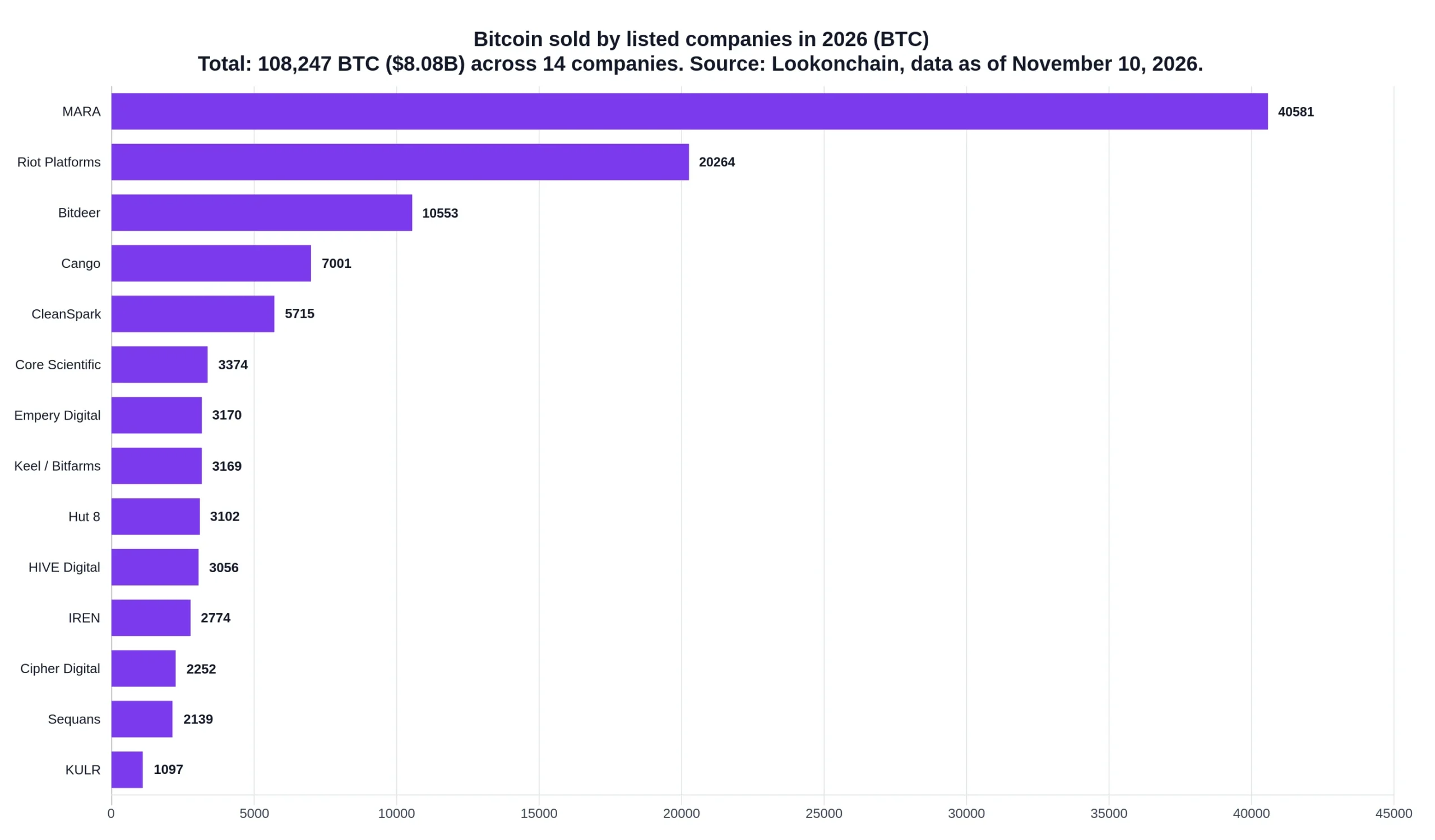
Bitcoin sold by listed companies in 2026, in BTC. Total 108,247 BTC, or $8.08 billion. Source: Lookonchain, data as of November 10, 2026.
One company’s filings reconcile to the tracker almost to the coin
The most useful check on any aggregate is whether a single line item survives contact with a regulatory filing. MARA’s does. Its shareholder letter states that it sold approximately 26,984 bitcoin in the first nine months of 2026 and 13,597 after the quarter closed to retire bitcoin-backed debt. Add the two and you get 40,581, exactly the figure Lookonchain attributes to the company. The dollar amounts line up as well: $1.9 billion plus $1.1 billion is $3.0 billion against the tracker’s $3.03 billion.
That reconciliation matters because it changes how the rest of the table should be read. MARA did not sell because a lender called. It sold because the coins were the cheapest source of cash on its balance sheet. The letter says the company manages “cash, bitcoin, debt, and access to capital as parts of one balance sheet,” and that it intends to keep using bitcoin to build cash for AI infrastructure commitments, to meet the puts on convertible notes that become exercisable next year, and potentially to repurchase shares under a $500 million authorisation approved after quarter-end. Total debt has come down $1.4 billion, or 37%, since January.
The scale of what remains is easy to lose in the selling. MARA held 34,012 bitcoin at September 30, including 19,260 that were loaned or pledged, and mined 2,247 coins during the quarter. Selling 13,597 after quarter-end would leave roughly 20,400 coins before October and November production, worth about $1.5 billion at today’s price.
KULR shows the other kind of exit
The smallest row on Lookonchain’s table is also the cleanest to verify. KULR Technology Group sold all 1,099.09 bitcoin it owned during the third quarter for net proceeds of about $80.1 million and used part of the money to repay a $20 million Coinbase credit facility, according to its third-quarter results filed with the SEC . It ended September with $54.5 million in cash, no borrowings and no digital assets, having exited bitcoin mining effective July 2026. The filing states the company “no longer holds or intends to acquire or mine digital assets.”
Net proceeds of $80.1 million against 1,099.09 coins imply about $72,900 a coin, below the $74,749 that the table’s dollar column implies for the same row. The difference is not a contradiction. It is a reminder that the value column is an approximation built on a reference price, while a filing reports what actually landed in the bank after fees.
Where the table stops being a sales ledger
Two of the rows carry their own footnotes. Bitdeer’s 10,553 BTC is marked “Estimated Jan–Sep outflows,” and CleanSpark’s 5,715 BTC “includes 3,654 BTC in options/basis-related deliveries.” Neither is a plain record of spot sales. An option delivery can move coins without a company deciding to sell at the market, and an outflow estimate can capture coins moving between custody arrangements as easily as coins changing hands for dollars.
The arithmetic inside the table has soft spots too. Core Scientific’s stated average of $85,000, applied to its 3,374 BTC, implies about $287 million, but the value column shows $252 million. Empery Digital’s $66,733 average implies about $211 million against the $236 million shown. Hut 8’s $80,658 implies about $250 million against $231 million. Where an average and a value disagree by that much, at least one of them is being calculated from a different base than the label suggests. The totals still add correctly, 108,247 BTC summing across all fourteen rows, but individual cell values deserve caution.
The limitation is structural, not a criticism of the tracker. There is no public register of corporate bitcoin sales. Everything in the table is reconstructed from on-chain flows, company disclosures and quarterly filings, and only the disclosures carry an audit trail. Twelve of the fourteen rows cannot be checked against a filing by an outside reader on any given day.
The countercase: half a percent of supply is not a stampede
Set against the size of the market, the exit is small. The 108,247 coins equal about 0.538% of the 20.11 million bitcoin in circulation, and $8.08 billion is roughly 0.545% of bitcoin’s $1.48 trillion market capitalisation. For comparison, bitcoin’s daily spot volume across major venues regularly exceeds $30 billion. A year of corporate selling is a couple of days of ordinary trading volume, spread across twelve months.
There is also a competing explanation for the whole exercise that has nothing to do with conviction. Miners spent 2026 converting power contracts and land into compute capacity, and the companies with the largest bitcoin stacks were also the ones with the largest capital programmes. MARA’s letter describes bitcoin as a source of “financial flexibility” that it may hold, monetise or borrow against depending on market conditions and expected returns on the proceeds. That is the language of treasury management, not of an exit from an asset class.
The bearish reading is not unreasonable, though. Coins sold are coins sold, whoever sells them and for whatever reason, and a cohort that sold above the current price has already demonstrated it can time the market better than the average holder. If bitcoin stays below $74,000, every one of these sales looks smart in hindsight, and the incentive to sell the next tranche gets stronger rather than weaker.
What would settle the argument
Three disclosures will decide whether 2026 was a one-off balance-sheet repair or the start of a longer distribution. The first is MARA’s fourth-quarter letter, which will show how many coins remain after the November sale, whether the company sold more into the fourth quarter, and how much of the $500 million buyback it actually used. The second is Riot’s quarterly filing, because a miner that has not sold at scale would break the pattern the aggregate implies. The third is CleanSpark’s treatment of its options and basis-related deliveries, which will show whether the 3,654 coins were a financing mechanic or a genuine reduction in exposure.
Watch the price at which the next tranche clears. If the cohort keeps selling above spot, the corporate treasury trade is being unwound by choice, at a profit, and the market is absorbing it. If sales start clearing below spot, the same table will mean something different: not treasury management, but the beginning of a queue.
For now the record supports a narrower claim than the headline. Fourteen companies did sell 108,247 bitcoin in 2026, and the dollars they raised were, on average, slightly better than the price available today. But more than half of the total came from two miners retiring debt and funding compute, one company left bitcoin altogether, and the rest of the list is small enough that the word sector does more work than the numbers justify.