HSBC’s Hong Kong dollar money market fund now sells a tokenised unit class, and RedCoin, the bank’s own stablecoin, is the rail it was built around. The class, HSBC Global Money Funds – Hong Kong Dollar (Tokenised Class), is offered only in the primary market, carries 0.38% in ongoing charges, and names Ethereum as its first public blockchain. The October 2026 key facts document sets a HK$10,000 minimum, about US$1,282 at the 7.8 peg.
That is the same share class HSBC flagged on 23 October, when it launched RedCoin to 3.3 million PayMe users. The bank’s release said it would “enable customers to subscribe to tokenised investment products via HSBC RedCoin,” including “a soon-to-be-launched share class of HSBC’s long-running HKD money market fund.” The launch was reported on 19 November. HSBC has not published a standalone press release for the share class, so the terms below come from the fund’s own offering documents rather than from a marketing summary.
What HSBC actually put on-chain
The token is not a new fund. The fund’s key facts document is explicit that “tokenised units are created in the same manner as other classes of the Fund” and that “a tokenised unit shall have exactly the same rights as a non-tokenised unit.” What changes is the record and the route to it.
One token, or a fraction of one, represents one tokenised unit, or a fraction, in the off-chain register. Subscriptions and redemptions run through an Eligible Distributor, defined in the document as an SFC-licensed virtual asset trading platform or a licensed corporation. Those distributors hold digital wallets with a token custodian, keep a fiat settlement account for their clients, and maintain the ownership record for their own end-investors. The registrar, HSBC Institutional Trust Services (Asia), keeps the official register off-chain, and that book-entry record, not the token, constitutes ownership.
The permissioning is deliberate. The tokenisation agent, The Hongkong and Shanghai Banking Corporation, registers and associates each digital wallet with identifying information held in a private database. The document calls this “whitelisting” and says it “prevents transactions between unknown persons or unknown blockchain wallets, even though blockchain infrastructure itself remains permissionless.” Settlement finality is also off-chain: cash moves outside the chain even when the unit record moves on it.
Two limits follow. The document states that “tokenised classes of units of the Fund are only offered in the primary market and there is no trading on any secondary markets,” and separately that “the Manager does not intend to allow peer-to-peer transfer or trading of tokenised Units on any secondary market.” A holder who wants out redeems through the distributor at the fund’s next determined price, not into an order book.
The 0.38% is not the whole bill
Ongoing charges for Class SD and Class T are 0.38% a year. The management fee is currently up to 0.30%, and the trustee fee is 0.03%. On the HK$10,000 minimum, that 0.38% works out to about HK$38, or US$4.87, over twelve months. On a minimum ticket the drag is close to irrelevant next to the effort of opening a distributor account.
The fixed costs sit elsewhere, and they are charged at the class level. The document says the tokenisation agent is currently charging “a maintenance fee which is up to US$1000 per month per tokenised Class.” That is US$12,000 a year before any gas cost, which the units also bear. Divide US$12,000 by 0.0038 and the break-even is US$3.16 million: only once the tokenised class holds roughly that much does the fixed tokenisation fee fall to the same weight as the fund’s own ongoing charge. Below it, the plumbing costs more than the management.
Three further charges sit outside the headline number. Blockchain network fees are paid in the chain’s native token. Switching between classes is not permitted for the tokenised units. And the maintenance fee can move: the document says unitholders get at least one month’s notice if the tokenisation agent introduces transaction or processing fees, alongside SFC prior approval where required.
Why Ethereum, and what the chain does not do
Ethereum is named as the primary blockchain, described as “a public and permissionless blockchain network,” with scope for other public chains later if the manager and tokenisation agent judge them to carry a comparable level of security resilience. The fund itself holds no ether. At least 70% of net asset value must sit in Hong Kong dollar short-term deposits and high-quality money market instruments issued by governments, quasi-governments, international organisations, financial institutions and corporations. No instrument may carry a remaining maturity above 397 days, or two years for government and public securities, and the weighted average maturity and weighted average life are capped at 60 days.
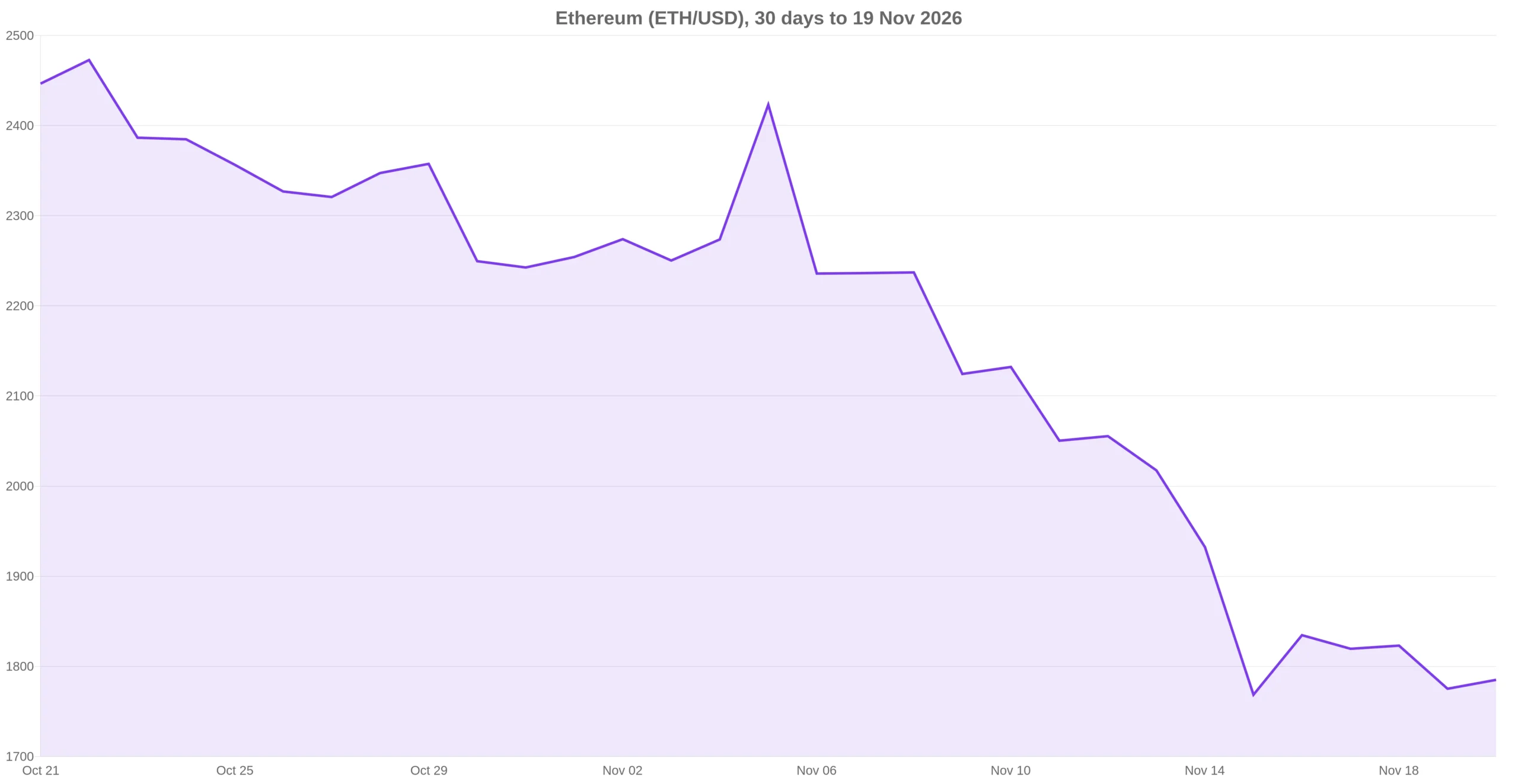
So the token’s exposure is to Hong Kong dollar short rates, not to the price of the chain it settles on. Ether traded at US$1,786.91 on 19 November, down 11.71% over seven days and about 27% over thirty, from US$2,446.49 on 21 October, with a market capitalisation near US$218 billion, according to CoinGecko . A fund using that ledger is buying settlement infrastructure, and it is buying it while the asset that secures the ledger is in a drawdown.
Where this sits in the tokenisation queue
HSBC is not first. J.P. Morgan expanded its tokenised money market funds to Solana in October, and the Hong Kong Monetary Authority pushed its EnsembleTX settlement pilot to round-the-clock operation with 32 participants. What differs here is the entry point: a stablecoin issued by the same group as the fund, distributed through a retail app that already holds 3.3 million users, with merchant acceptance above 100,000 outlets for payments.
Maggie Ng, HSBC’s chief executive for Hong Kong and head of retail banking and wealth, framed the wider shift at the RedCoin launch: “Money, assets and information are moving from traditional infrastructure to always-on, data-rich and increasingly programmable digital networks.” A money fund share class is the first place that claim meets a deposit-style product.
HSBC’s digital asset stack gives the fund a plausible home. The bank already runs HSBC Orion for digital bonds, HSBC Gold Token for retail customers and the Tokenised Deposit Service for wholesale payments, all named in the October release. A tokenised money fund is the first product in that list aimed at ordinary deposit-style savers rather than institutions or gold buyers.
The regulatory labelling deserves care, because two different regulators appear in the same story. RedCoin is licensed by the HKMA under Hong Kong’s Stablecoins Ordinance. The fund is a collective investment scheme whose tokenised class is documented under SFC rules. The key facts document says plainly that “the Fund is not subject to the supervision of the Hong Kong Monetary Authority,” and that buying a unit is not the same as placing money on deposit with a bank.
What HSBC has not said
There is no disclosed asset base for the tokenised class, so the break-even calculation above cannot yet be tested against real flows. There is no published timeline for a second blockchain, no commitment to secondary trading, and no indication that the HK$10,000 minimum will fall. The fund’s own documents leave the manager room to accept smaller subscriptions, but the stated minimum in the key facts remains HK$10,000 for both initial and additional investment.
Redemption mechanics are the part retail buyers tend to skip. Units are bought and sold at the fund’s next determined subscription and redemption price with reference to net asset value, calculated on each dealing day, and Eligible Distributors may impose earlier cut-off times than the fund itself. The official record of ownership stays with the registrar, which means a token holder’s claim depends on the distributor’s records matching the register.
What would change the picture
Three developments would move this from a pilot-scale product to a piece of Hong Kong’s retail plumbing. The first is scale: once the tokenised class passes roughly US$3.2 million, the fixed tokenisation fee stops dominating the cost stack and the 0.38% becomes the number that matters. The second is distribution: the class can only be sold through SFC-licensed virtual asset trading platforms or licensed corporations, so the addressable base is the wallet infrastructure those distributors have built, not the 3.3 million PayMe accounts by themselves. The third is liquidity: without a secondary market, the token behaves like a fund share with a chain-based record, and any approval of trading would change how holders price their exit.
Until then, the honest description is narrow. HSBC has put a tokenised wrapper on a HK$10,000-minimum Hong Kong dollar money fund, settled on Ethereum, open through whitelisted distributor wallets and funded with a stablecoin the bank issues itself. That is a real change in how a bank distributes a fund. It is not yet a change in what the fund holds.
Frequently Asked Questions
HSBC said in October that it would enable subscriptions to tokenised investment products through RedCoin and named this share class as the first. Access runs through an Eligible Distributor, which the fund documents define as an SFC-licensed virtual asset trading platform or a licensed corporation, not through a public exchange listing.
Ethereum is the primary blockchain, described in the key facts document as a public and permissionless network. The manager and tokenisation agent may add other public blockchains that they consider to have comparable security resilience. No second chain has been named.
The 0.38% is the ongoing charge for Class SD and Class T, within which the management fee is currently up to 0.30% and the trustee fee 0.03%. On top of that, the tokenisation agent charges a maintenance fee of up to US$1,000 a month per tokenised class, and blockchain gas fees are borne by the tokenised units.
No. The document states that the tokenised classes are offered only in the primary market with no trading on any secondary market, and that the manager does not currently intend to allow peer-to-peer transfer of tokenised units.
The registrar, HSBC Institutional Trust Services (Asia), maintains the official record of ownership off-chain. The token is a digital representation of a unit in that register, and the fund documents say tokenised units carry exactly the same rights as non-tokenised units of the same fund.
Data: HSBC Key Facts , HSBC Prospectus , CoinGecko .
This article is for information only and is not investment advice. Tokenised fund units carry market, liquidity, smart contract and settlement risks. Read the fund’s offering documents before investing.
The post HSBC’s Tokenised Money Fund Is Live, With Ethereum as the Ledger and a 0.38% Charge appeared first on BlockchainReporter .